
SANTA EULALIA – GAZING AT TAURUS (LIVE)
March 5, 2022 § Leave a comment
“Santa Eulalia – Gazing at Taurus” is the only song from The Tunnel and the Clearing for which I hadn’t done a video so far, so here goes…
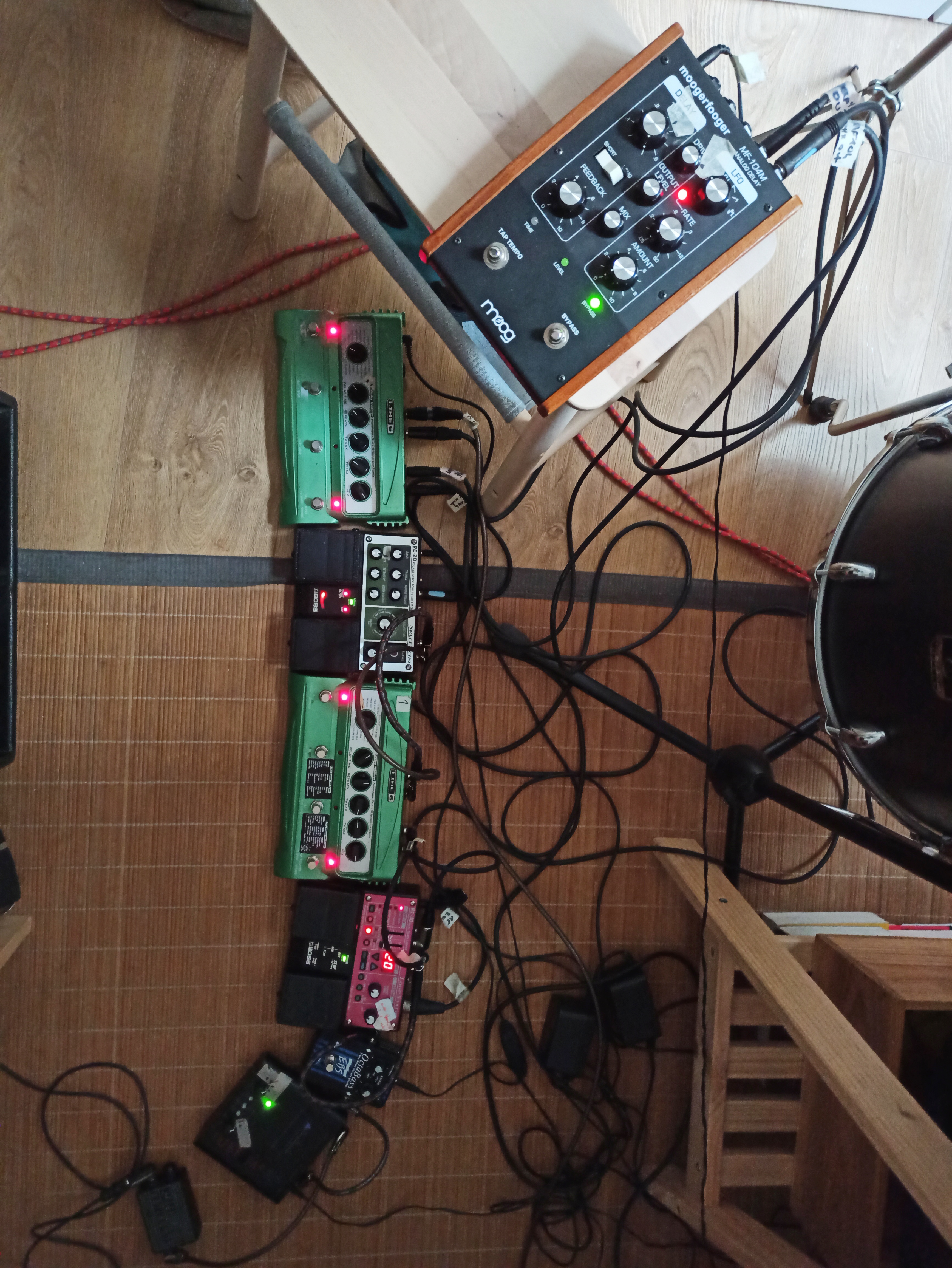
It’s a song that’s particularly dear to my heart because of its lyrical content, and because I really struggled to actually make it work, so when it did, it was such a relief. For weeks (months possibly?) I had almost everything: the rumba rhythm on the Elka Drummer One, the chord progression, the lyrics, the basic sound (Hammond emulation with slow rotary on, percussion on and a bit of reverb from the Reface YC, into my MF-104M Analog Delay), and I knew what mood I was after (a kind of “groovy sadness”, I guess?), and yet I just couldn’t get it to sound right through the first 2 versions that I made of the song.
Then one day out of desperation I thought “OK, I’m just going to play the chord progression as flat as possible, just one chord after another”… and it worked. It was more church-like than I intended though, and with such a simple drum machine + organ combination, you either go the Suicide way (= ie minimal to the bone right until the end) or you go for evolution and changes of intensity through the way you play and subtle sound treatment changes. I’m not a real organ or keyboard player, but I came up with a couple of “strategies”.
I used my favorite MF-104M trick twice: switching the short/long switch in rhythm. The long setting gives you a darker tone, so that when you switch rapidly you don’t just get a barely perceptible (because it’s so fast) time delay change, you also get a kind of flickering, semi-liquid tonal change.I
alternate “flat” playing with staccato playing and a kind of “staggered/stuttering” style during the chorus.I sometimes drop right-hand chords altogether to just play a slurred bassline.
And for the ending, increased feedback so that the texture is way more noisy than the rest of the song.
WORLD OF TREBLE VIOLA DA GAMBA
February 25, 2022 § Leave a comment

Sometimes an instrument changes your life. It’s happened to me several times over the course of 30 years: the guitar at age 15, the bass viola da gamba when I turned 30, my first real synthesizer (the Grandmother) in 2018 – but the treble viola da gamba holds a truly special place in my heart and in my life as a musician.

It’s one of the smaller versions of the instrument and is pretty rare even in its original context – baroque music – in which you only find it in viola da gamba ensembles. The idea is that it complements the other parts, it is never meant to be a solo instrument, and certainly it was never meant to be played the way I play it: tuned down, like a guitar with a capo on the 5th fret, played fingerpicked rather than bowed, amplified, delayed – in other words transformed.
As with some of the good things in life, it took me a pretty long time to actually get there: I commissioned it in 2008 to my luthier who had made the bass viola, the incredibly talented François Danger of Atelier des 7 Cordes, who unfortunately passed away prematurely 2 years ago. I firmly believe that if my treble viola had been of inferior quality, I could never have gotten away sonically with what I did to it. My dream was to have a small portable instrument which I could fingerpick to get a harp-like sound and still bow. I hadn’t expected I would hit a massive wall: a near-burn out coupled with a deep creative crisis that left me silent for all of 2009, and from which recovery was slow (there is a 6-year-gap between 2007’s Les Ondes Silencieuses and 2013’s The Weighing of the Heart).
In 2010, reading Tim Lawrence’s stellar biography of Arthur Russell and immersing myself in his music and fearless way of doing things was the first step to me feeling like making music again. I started to sing, to play percussion, and coincidentally moved to San Sebastián, Spain, where I got a space which I used as a music studio. It wasn’t perfect, but cutting myself from daily life was of tremendous help. As I slowly emerged from my creative cul-de-sac, I remembered the treble viola, which I felt terribly guilty for not using.
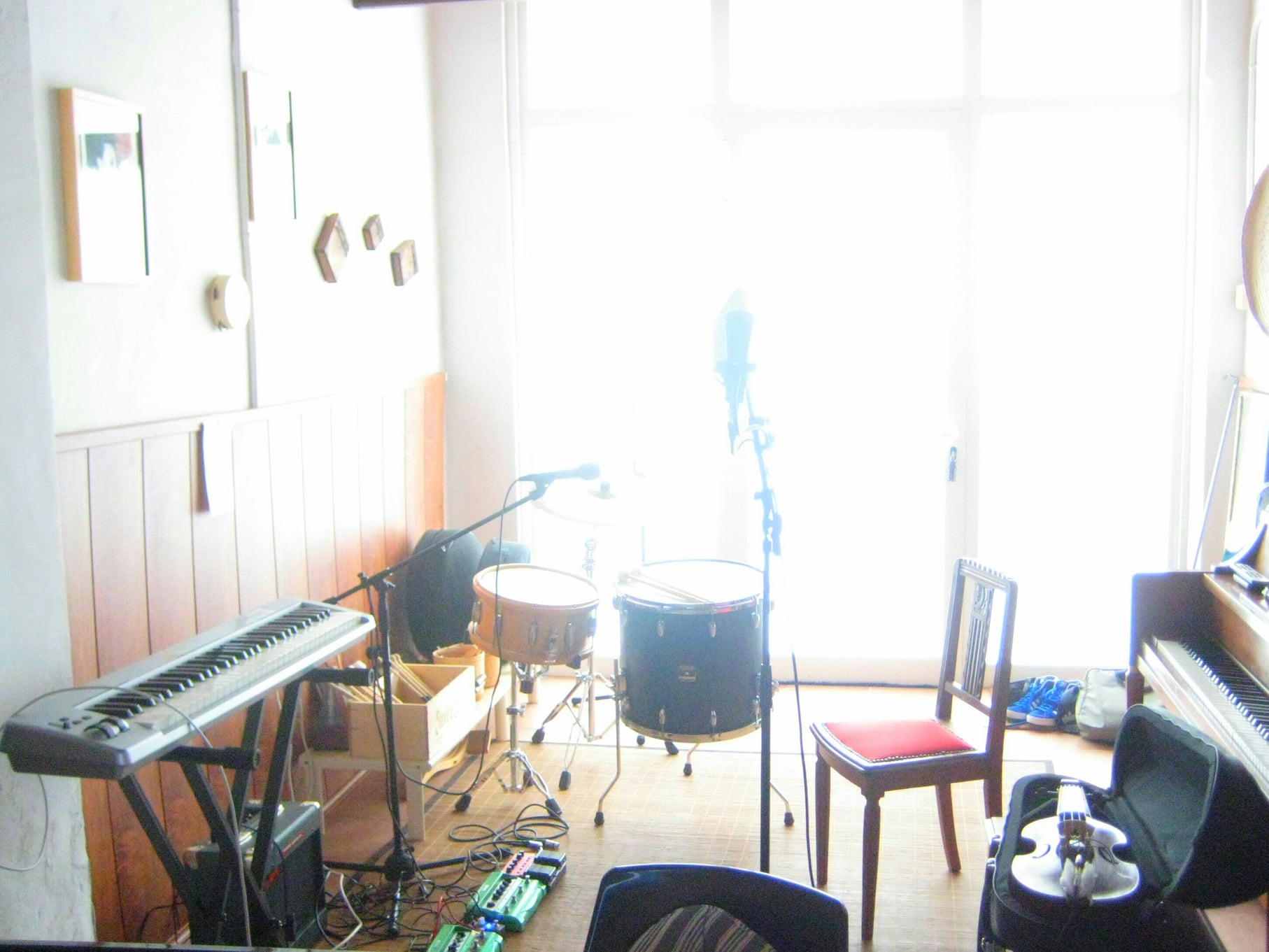
I never really liked how high-pitched the treble viola da gamba was, so I just decided to tune it down. The decision to try and tune it like a guitar came almost instinctively, and when I did, all of a sudden everything made sense. At the time I was listening intensively to many string instrument traditions from Africa, Central Asia and the Middle East, and all of these went into the search for a personal way of playing my unfamiliar, newly-transformed instrument.
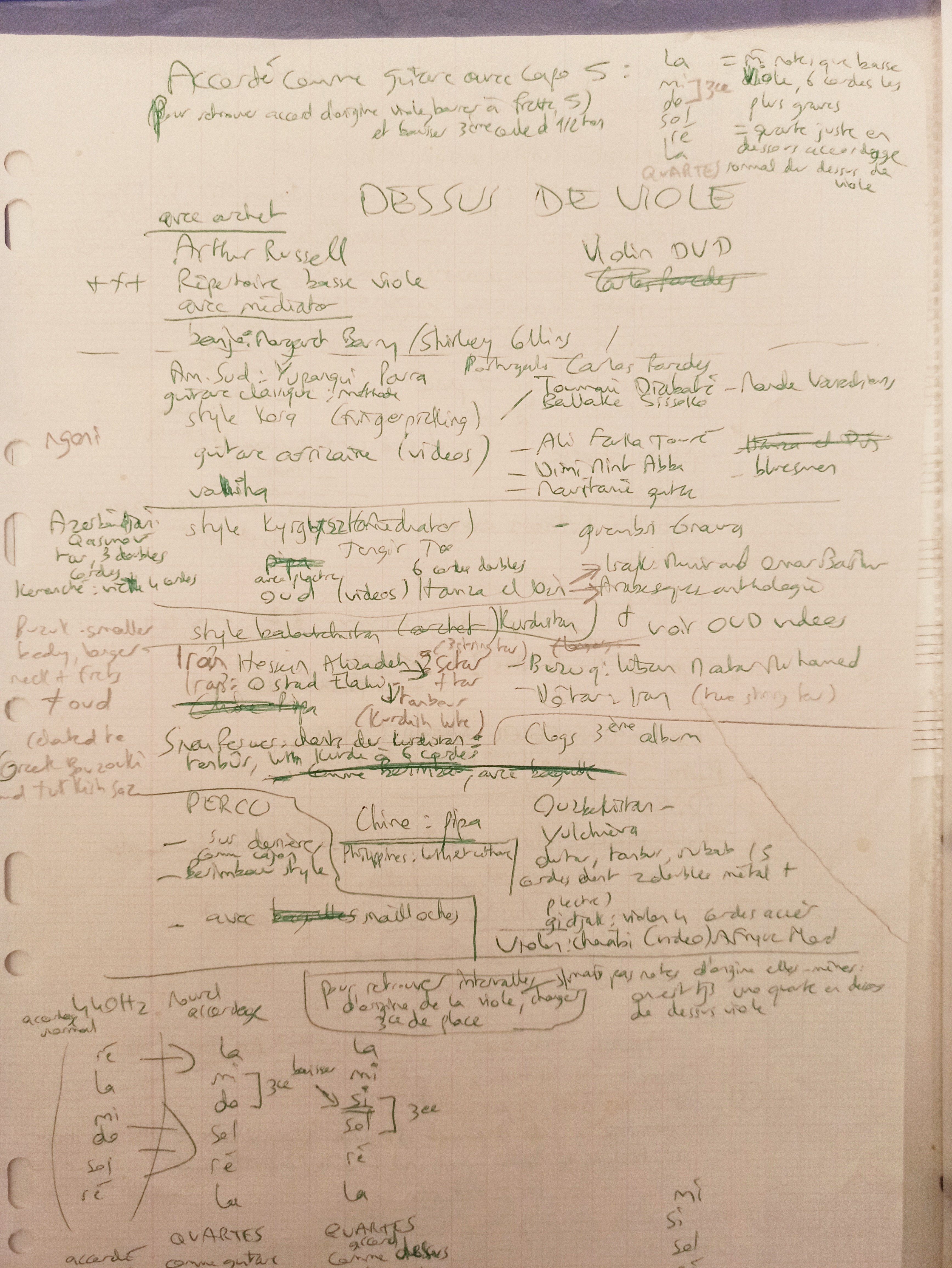
“Geometría del Universo” was the very first song I wrote on it, and you can see from the tabs written in different pen colours, that it happened over various work sessions. It took me so long to understand what the best positions for the instrument and my hands would be that when I hit on something that worked, I made super precise notes for fear I would forget. The treble viola first appears on what is admittedly my most diverse album in terms of instrumentation and influences, 2013’s The Weighing of the Heart, along with its big sister the bass viola da gamba, which was the main instrument on what I guess was my “baroque minimalist” album Les Ondes Silencieuses from 2007.

My 5th album Captain of None was the unlikely meeting of my new favourite instrument with an old love of mine, Jamaican music and dub in particular. This took the instrument even further out of its original territory, transforming it into a bass thanks to an Octabass octaver pedal. I stopped playing the viola after that album because I felt I had nothing better to say with it than what I had already said.
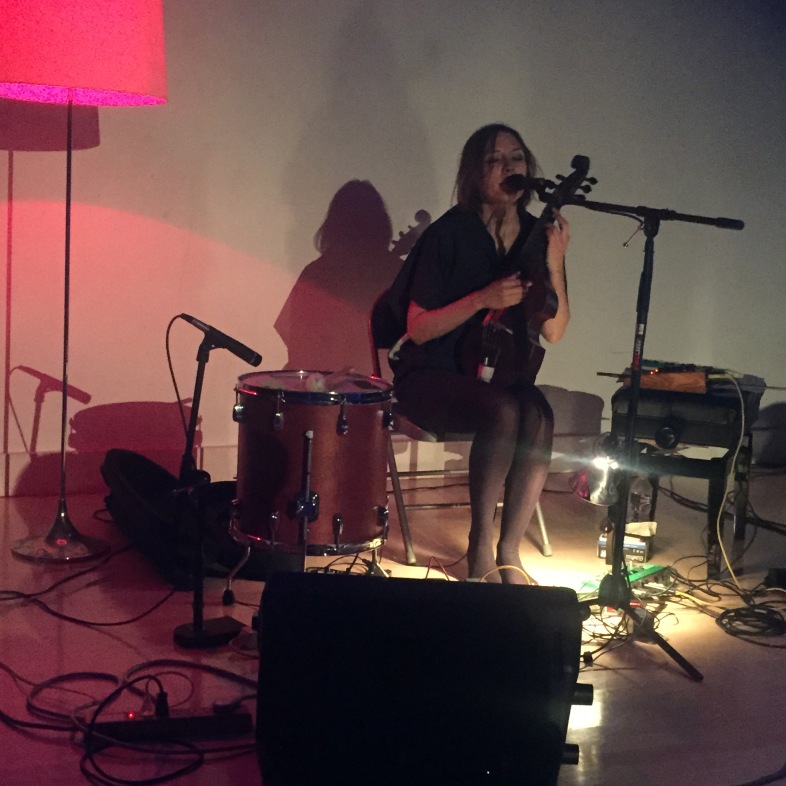
Rehearsing this repertoire now for my 2 upcoming shows in Barcelona and London makes me feel incredibly lucky that I did construct such a relationship with the instrument. The older I get, the more I get this sense that as musicians, we get back from music *exactly* what we pour into it in terms of energy, dedication and sheer love. In that sense, music never disappoints.
16 INPUT SOUNDCARD / MIXING DESK HYBRID SETUP.
February 5, 2022 § Leave a comment
As a self-taught producer, I’ve often had to wade through tons of information on the internet to understand how to meet my needs as both my approach and gear expanded. I am really happy with my latest setup, so want to share it in case it is of inspiration or help to anyone: 2 Focusrite soundcards (the latest Clarett +8 pre connected via ADAT to my older Scarlett 18i20 1st gen) + Soundcraft Signature 12 MTK mixing desk.
The 2 soundcards total 16 inputs, so I can send every single output of every piece of gear to its own input on the soundcards, enabling me to 1) have a separate recording for each piece of gear, allowing for more mixing and panning possibilities (crucial if you use few pieces of gear) 2) send signals live or prerecorded from my DAW (Acid) to another piece of gear via the 3 buses created in the DAW.
I use 3 outputs from the Clarett to physically send the bus signals to the first 3 channel strips on the desk. Without a desk, you could just connect the cables from the Clarett outputs straight into the gear input of your choice, but the advantage of a desk with 3 Auxes is that each strip allows you to send the bussed signal to 3 different pieces of gear at once. All my Auxes are set Pre Fader and go into my most used units (top right section of the desk): the Space Echo in AUX2, the MF-104M delay in AUX3, with either the Grandmother or a Moogerfooger occupying AUX1.
You can share “sending” duties between the desk and direct input on the units themselves. A concrete example with “Hidden in the Current” as a starting point: the Reface YC organ (which is the only instrument I connect directly on the desk) is sent into the Grandmother via AUX1 on its own strip. The Grandmother return is bussed into CH1 and sent into the MF-104M via AUX3. I end up with 4 tracks in my DAW: the Reface YC (muted), the Grandmother, and the MF-104M Mix and Delay outputs.
If I wanted to add drum machine and send it into the Space Echo, I would send the Elka Drummer One via BUS B to CH2 on the desk and into the Space Echo via AUX2. To further process anything else live, I’d use BUS C into CH3 or direct input on the unit of my choice.
STUDYING DIFFERENT WAYS OF PLAYING THE MOOG GRANDMOTHER KEYBOARD WITH ARPEGGIATOR AND HOLD ON – CYCLICAL PATTERNS PATCH.
January 31, 2022 § Leave a comment
I am adoring how a single patch can lead you to a myriad of possibilities, and the Cyclical Patterns patch from the Grandmother manual is doing just that for me. I intend to work through all available patches in the manual and the other free PDFs Moog have made available, but I haven’t moved on since coming across this one, as I have become obsessed with it. In this patch you take the output from the Oscillators, feed it into the Hi Pass Filter, then feed that back to the Noise Oscillator In. The interaction that then ensues from moving all those parameters (the 2 Oscillators with all their characteristics, the Noise Osc, the Hi Pass Filter, and of course everything else) is just mindblowing in its endless possibilities.
Another thing that has kept me busy is trying to find a way of playing this synth in a way that feels personal and like I’m actually *playing* an instrument, ie making conscious (although sometimes spontaneous and/or semi-improvised in origin) interpretation choices and decisions – not entering random notes on a keyboard for arpeggiating or sequencing, which seems to be a recurrent feature in a lot of gear demos. I sometimes play the keyboard as if it were just that, a keyboard instrument, with no Arp on, the challenge being its monophonic nature, which is pushing me to work extra hard on bass lines, chord inversions, and a kind of “stuttering” way of playing to get a chord-like feel.
But I find the interaction between Arp mode, Hold button and actual playing particularly interesting: it really makes a difference how you play, and with my favorite addition to the Grandmother being a delay – in this case the MF-104M – the way the Grandmother gets “caught” – or not – by the delay is really dependent on that. For the first two repeats I am using my right hand in a mallet-like way, then on the 3rd repeat I’m leaving my fingers on, which is kind of killing the delay, then on the 4th I manage to get a bit more delay by slightly lifting them. I think I prefer the “mallet” style.
IMPLOSION-EXPLOSION – extended ending for live shows.
January 25, 2022 § Leave a comment
This is what it sounds like when I keep playing “Implosion-Explosion” with the settings as they are at the end of the song: extreme delay on the Moog MF-104M Delay (the Feedback pot is at 7) means the MF-101 filter sounds even crazier that way, reminding me of the way the wind sounds in harbours against sails or flags. This is just the Yamaha Reface YC in its Ace organ setting sent into the Filter, itself bussed to the Delay, and this ending can truly sound amazing in a live context, and varies every time, as the way the 2 pedals interact is so subtle and depends so much on how much drive there is in each one of them. To me this is truly where the magic of analog lies.
Drum machine: Elka Drummer One into Roland RE201 Space Echo, both @soundgasltd
NEXT SHOWS in Barcelona @elpumarejo 11th March and London @kingsplacelondon 19th March – details in LIVE section
 colleen