MOOGERFOOGERS AS PREAMPS AND DRIVE UNITS + ELKA CLEANING
November 29, 2021 § Leave a comment
ON GEAR ACQUISITION SYNDROME AND USING MOOGERFOOGERS AS PREAMPS AND DRIVE UNITS.
I am not prone to GAS (Gear Acquisition Syndrome, for those of you not familiar with the condition). I was very close to Instrument Acquisition Syndrome in the 2000s, but thankfully, square metre shortage in Paris, where I lived back then, ensured that I did not buy 70s organs, or other such space-consuming monsters.Now that I have discovered the joys of analogue instruments, especially vintage ones, I sometimes catch myself wishing for more. But that’s the thing: I catch myself. Knowing full well that with my current setup, truly, I can work for a couple more years at the very least, and not feel limited. If any feeling of limitation were to arise, it would be down to me not spending enough hours with my instruments – one of life’s many unpalatable cold hard truths. I may still buy something if I truly think it will bring something unique to my setup, but at least I’m aware of how desire operates: mostly out of magical thinking, whereby we convince ourselves that once we get this or that instrument/piece of gear, *then* we will make truly incredible music (the next step of magical thinking exists and is as follows: the instruments will make music on their own.)
In the spirit of “let’s not rush to buy a new thing – as wonderful as it may be – when we actually already own something that may serve the same purpose”, I have now clarified for myself the fact that *all* Moogerfoogers can be used as analogue preamps/drive units, *without* the effect they’re intended to provide.Their bypass behavior puzzled me for a long time, as it varies across the pedal range, so testing each one both on and bypassed (as well as re-reading the manuals  ) has helped me a lot. Since the question arises in forums, I am publishing the table here in case it is of any help to anyone (my explanations are a little overkill, but that’s just me
  ). Since my Moog session was meant to celebrate them, there couldn’t be a better time to publish this: discontinued they may be, but their price has risen on the second-hand market, given that yes, they were really special.

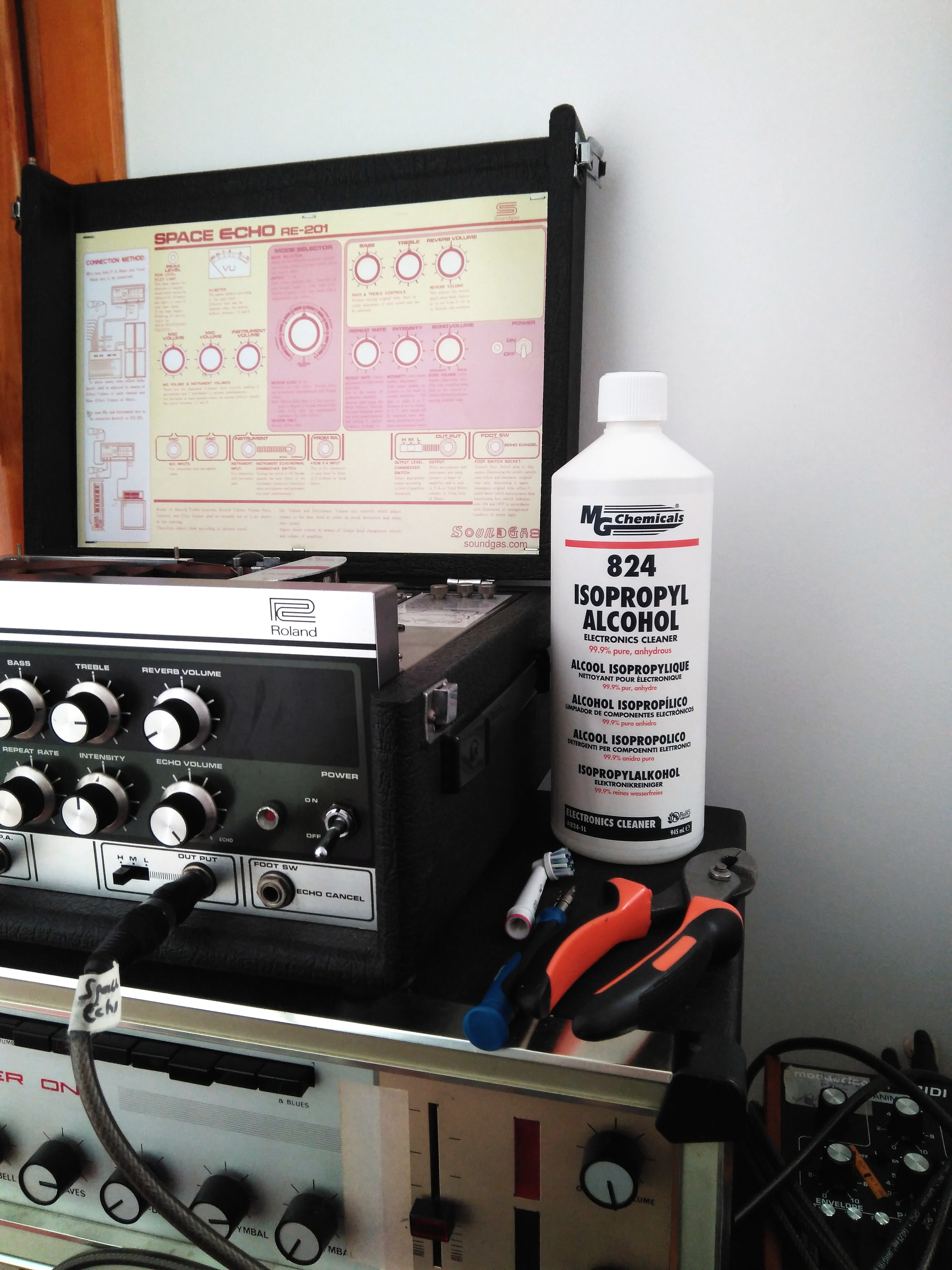
ELKA DRUMMER ONE POT CLEANING AND TRANSPLANT.
In July 2020 I had to clean some scratchy pots on my Elka: this involved squeezing a special cleaning liquid called DeoxIT directly into the pot mechanism (as opposed to just spraying something on the outside), which of course meant opening the machine. It was the first time I opened *any* piece of gear, let alone a vintage one, so I was extremely nervous, but totally awed by what I found inside.

At the time, I had to send the Elka back to Soundgas, as the procedure did not work for 2 out of the 4 scratchy pots, which probably meant that the pots had “reached the end of their life”. This enabled me to learn of a new concept and practice “donor machines”: a donor machine is a piece of gear from which you remove parts that are then transplanted, as it were, on another machine. You are basically sacrificing it, piece by piece, for the good of various other machines.
Today’s cleaning operation was successful: 2 out of the 3 scratchy pots are now silent, and scratches appear only occasionally on the bass drum. Unfortunately another small issue has come up: some of you may have seen in my stories that I occasionally have to rescrew pots into their proper position (to have the white mark aligned with minimum volume, which corresponds roughly to a 7 o’clock position) as the pots tend to “slip” out of the knob underneath (they are held by a tiny screw called a grub screw). The knobs themselves function perfectly, but since the white mark gives a vital visual indication of volume, things quickly get confusing if minimum volume is indicated where half or full volume should be.Turns out the reason this keeps happening is that the plastic the pots are made of is becoming brittle with age. Indeed, today I checked this thoroughly, and almost all of the Elka pots are cracked to some extent. Since the 2 pots that have actually caused trouble are on Tom 1 and 2, which I use a lot, I decided to do my own transplant using 2 less used pots (Snare Drum and Cowbell). This seems to have worked for the time being, but Soundgas are working on finding a DIY solution to this problem.


MOOG SOUND LAB “A FLAME VARIATIONS” 4 YEARS AGO
November 15, 2021 § Leave a comment
4 years ago I headed to the Moog Soundlab Studio in Asheville, North Carolina, for what remains a highlight of my musical life: doing the session, visiting the Moog factory the next day, and – most unbelievable of all – being gifted the 3 Moogerfoogers I played with for the first time on the day of the session… I have kept this photo (credit: Spencer Kelly) as my profile pic on my social media for the past 4 years, not just because of how awesome that Moog wall looks, but because the glint in my eyes says it all, and I don’t want to forget how special that was and how privileged I felt.

The connection with Moog started in 2017, but I had no clue it would ever go this far: I was in love with both the MF-104M delay and MIDIMuRF, and since they made up half of the sound of my 6th album A flame my love, a frequency, I decided to just reach out to say I had just made an album that basically would not have been possible without the Foogers. I had just played Moogfest, which has connections with Moog, but couldn’t assume anything as to whether or not I would get a reaction, and to my amazement, I got a reply, saying that they already knew my work and loved it!
I knew I was going to tour the US in the fall of 2017 to support the album, and since Moog was about to announce that they would discontinue the Moogerfooger line, they asked if I would do a session focusing on these, and that’s how I ended up in front of a beautiful daisy chain of MF-101 Lowpass Filter, MF-102 Ring Modulator, MF-103 12-Stage Phaser, MF-104M delay, and a CP-251 for the last song. Jason Daniello, who heads Artist relations and is a synthetist and Moog specialist, helped me to get some amount of basic familiarity with the Foogers and CP251, and we recorded the whole thing in just a couple of hours, with me playing chords from the songs on my Critter and Guitari Septavox and Pocket Piano as sound sources, just like on the album.
You can listen and download the session for free or pay as you wish on my Bandcamp.
BARCELONA 12TH MARCH + LONDON 19TH MARCH 2022: DOUBLE ALBUM SHOWS: CAPTAIN OF NONE + THE TUNNEL AND THE CLEARING
October 22, 2021 § Leave a comment
I am super happy to announce that I will be playing@kingsplacelondon , London, on 19th March 2022 TICKETS HERE. This show was initially planned for August 27th and had to be postponed due to the 10-day quarantine rule. I will also play in my adopted hometown of Barcelona on 12th March at one of the best sounding venues I’ve ever had the chance to visit @elpumarejo with @furvoice opening and organizing @mutabor_music.
There is a silver lining to every cloud: the London show postponement not only enabled me to think about and prepare for this show differently, but also go back on my decision to stop live playing, which I had announced– after much hesitation – back in May. I feel the need to announce this already so that none of you decide to do some crazy travelling thinking that this is your last opportunity to see me live. I will write some more about this – it is a subject that has many ramifications for me. For now, all I can say is: I will play more shows, though for sure nothing will happen Stateside until 2023, because of the current visa situation in US embassies.
Regarding these two shows, I am overjoyed that I will get to play not one but two albums for you: I took up my treble viola da gamba, more or less to dust it off rather than with any intention to truly play it, a couple of months ago, and to my surprise realized my playing wasn’t as rusty as I thought, that I could still handle all the foot sampling operation needed to play Captain of None live (I last performed it @moogfest in spring 2017), and – most importantly – that I still absolutely loved playing that album. I really needed to recover brain bandwidth to truly believe that I could handle playing two albums that are totally different in terms of instrumentation and set up, and therefore require a lot of concentration and brain power, and paradoxically, it was my decision to stop playing live and the relief and relaxation it brought that enabled this.
LP8 IN FULL SWING
October 9, 2021 § Leave a comment
It’s the first time I’m recording an album so soon after completing the previous one (I finished The Tunnel and the Clearing on 1st December 2020) and it is so exciting to be riding a creative wave stronger than any I’ve known so far. The way I’m feeling right now is that I have the enthusiasm of a 15-year-old coupled with the experience of a 45-year-old: it is not something I expected to feel at any point in my life, and I can’t quite believe it’s happening right now, but it is. Recently rehearsing Captain of None also gave me a nice sense of continuity. And it helps that I live in a vibrant city ❤️

Earlier this week I reorganized my studio to accommodate the Grandmother-and-Fooger-centric workflow I’m digging deeply into right now: I wasn’t expecting to go down that particular rabbithole for LP8 but I am 100% in love with what I’m finding out every single day through patient studying and experimenting. I also love Sol’s face as he discovered the new setup! The orange hue is not a filter by the way, it’s the color of the studio’s overhead lightbulb :-)))
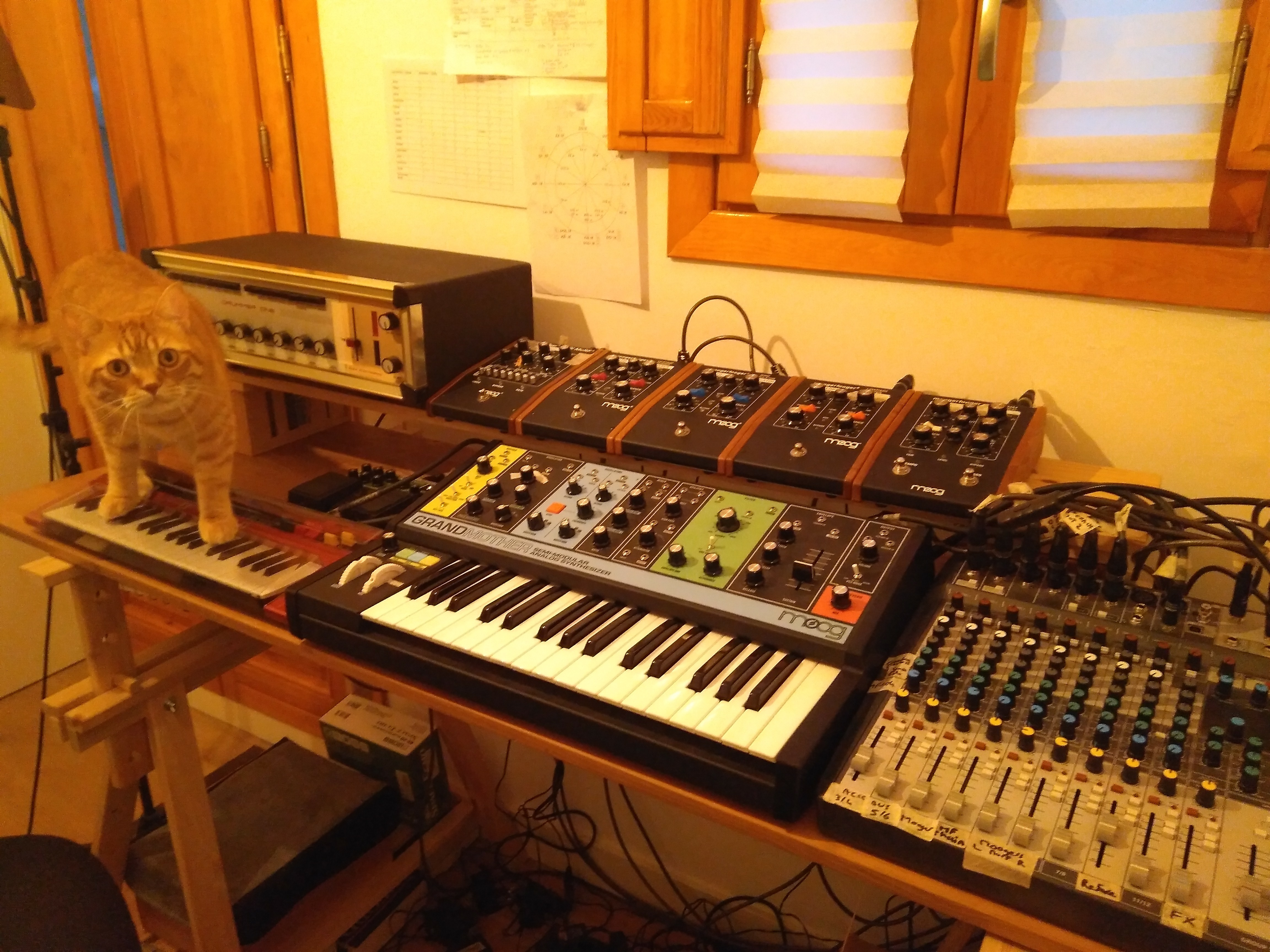
As usual when I start work on a new album, things don’t exactly go the way I have planned them, and this is usually in the best possible way. I thought I would dive straight into an Elka Drummer One + Space Echo extravaganza (and I *will*, at some point), but because the Space Echo had to travel to the UK for a revision with Soundgas (it’s on its way back), I ended up focusing on the other side of the album’s sonic equation: the Grandmother and the Moogerfoogers. I thought I would keep on feeding my Yamaha Reface YC into the Grandmother for processing, since I was so happy with the results on “Revelation” and “Hidden in the Current” on the last album, and indeed I even made a complete song with that setup, but… but… I started using the Grandmother as what it really is, a synth, and it’s official: I have totally gone down the synthesis rabbithole.


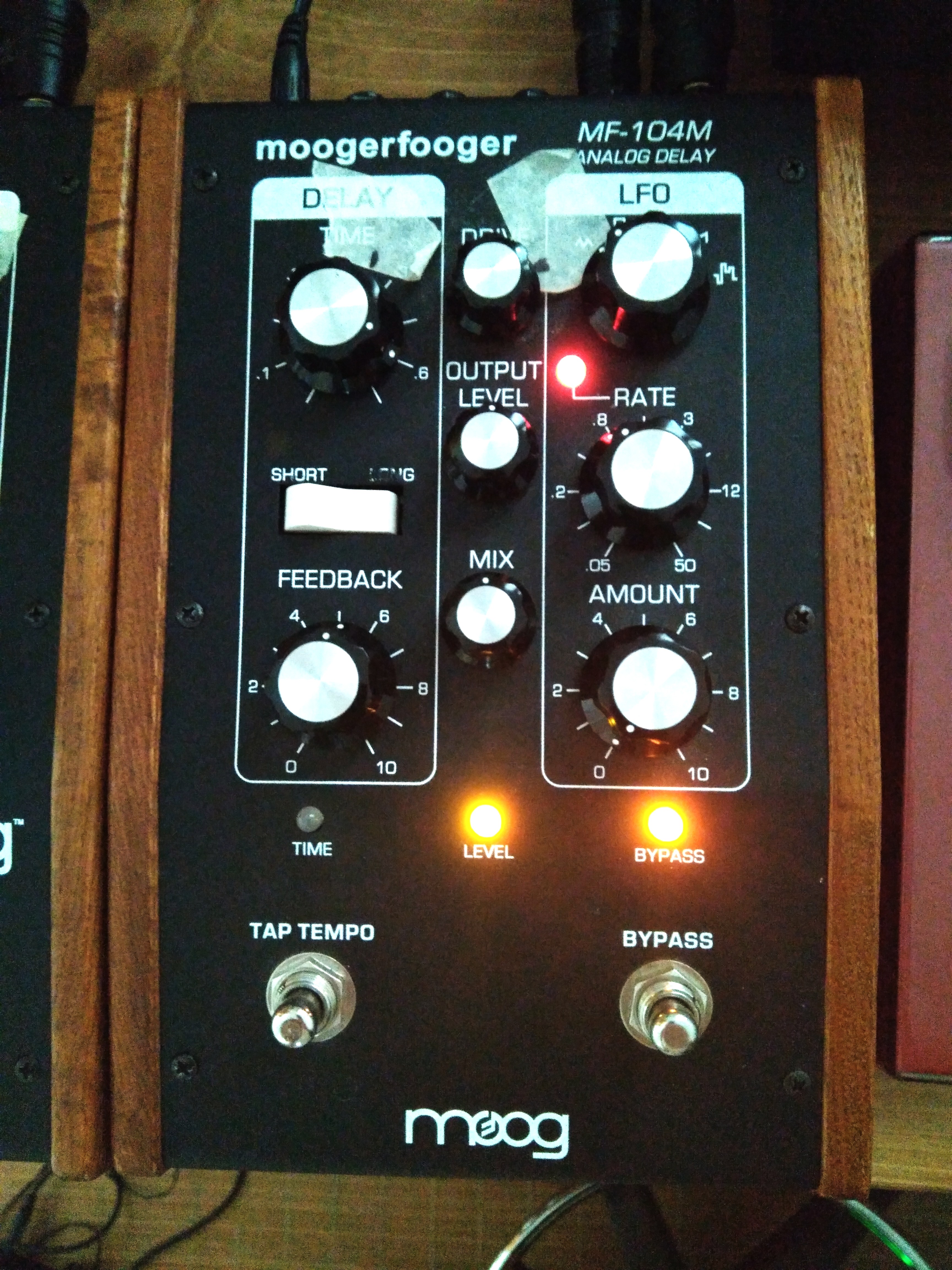
When combined with the Moogerfoogers, the possibilities just seem endless, and that’s even before any patching happens… I am also so happy I’m finally having a proper go at the Moogerfoogers I was so kindly gifted with by Moog after my 2017 Moog Soundlab session: I worked a lot with the MF-104M delay from 2014 onwards, and the MIDIMuRF played a huge part in 2017’s A Flame my Love, a Frequency, but I only used the Lowpass Filter once on the last album (“Implosion-Explosion”), and I had yet to use the Ring Modulator and 12-Stage Phaser. Now is the perfect time to finally honor that gift.
As I go through this crucial learning and research phase, there is also a voice at the back of my head that says “But these aren’t your songs yet”. It also says “These aren’t even songs yet”. And that voice is always right. Because one thing’s clear to me: I am primarily a song-maker, and I personally am convinced of the fact that it is up to each individual creator to try and offer something unique and personal before putting it out on a totally saturated market. In other words: I don’t think you should listen to me unless I have something that only I can say. So I am excited at the thought that pretty soon the next phase of LP8 will naturally start to unfold, one in which life itself begins to seep into the machines to dictate what sound transformed into songs will sound like.


SPACE ECHO TALES
September 29, 2021 § Leave a comment
SPACE ECHO TALES – PART I: ALL IS WELL UNTIL IT ISN’T.
I’ve been sitting on these posts since June: I didn’t want to write them under the spell of the anger I felt towards the person in Barcelona who messed up my Space Echo instead of repairing it, nor under the spell of the “triumphalism” I did feel when I managed to not only undo the damage done by that “technician”, but actually solve the problem that had led me to consulting him in the first place. I wanted to see how the Space Echo would evolve over time, and now I have, so here goes, 3 posts with technical details, so that those of you who also own precious vintage gear can hopefully learn something from my experience, and about how to maintain a Space Echo 😊

RECAP.
December 2019: after several years of salivating at the thought of owning a real tape delay, I order a Roland RE201 Space Echo from Soundgas. My mind is blown from the first second of use.
May 2020-December 2020: I use the Echo for hundreds of hours while I compose, rehearse, then record The Tunnel and the Clearing, keeping the same tape in a kind of fetishist way, as the idea of it aging just works so well with what the album is about.
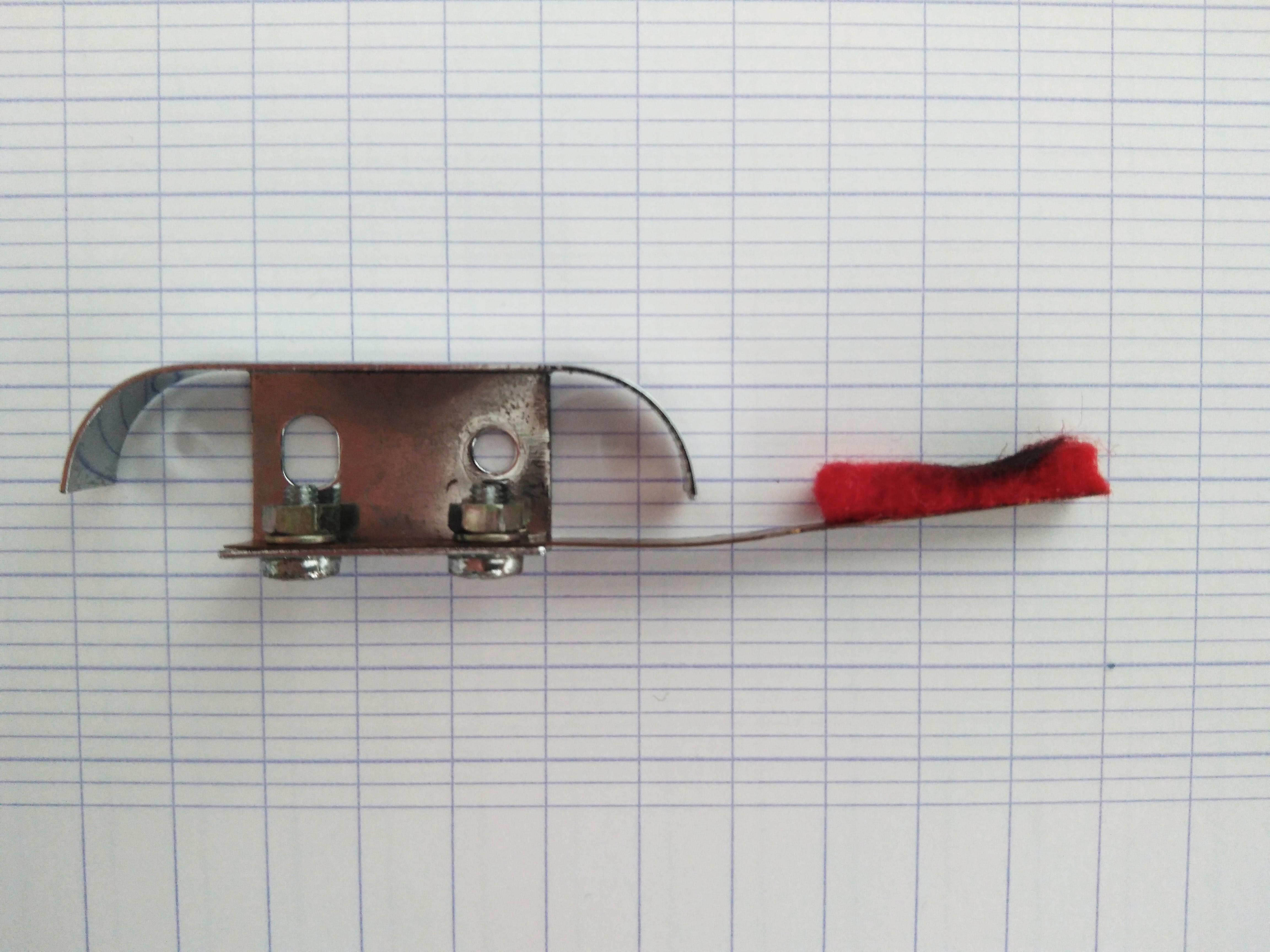
In spring, I finally decide to change the tape to a fresh Soundgas-approved tape. It is probably at that point that by my own lack of experience and knowledge, I bend the tension arm (pictured in the first pic) as I proceed to replace the tape (PS: it is possible that the arm was bent even further by the “technician” who subsequently handled the Echo, but I can’t be sure). Everything sounds fine for the first few days, but in early May, a couple of weeks before the only shows I had planned for the release at Chiquita Room in Barcelona, the Echo – to my horror and incredulity – starts developing a very noticeable “warped” sound whenever the splice of the tape passes through the tension arm.
We exchange many emails with Soundgas to try and see what the problem might be, and whether or not I can fix it from my end, because there is no time to send the Echo to England for a repair and have it back in time for the shows, not with newly-enforced Brexit, not with slow and rapacious Spanish customs…
SPACE ECHO TALES – PART II: DON’T TRUST STRANGERS.
Soundgas quickly identify the tension arm as being the likely culprit of the warped sound, and I am sent on a mission to find a very specific gauge to adjust it. I am not able to find it. By chance, a few weeks earlier, a fellow musician had recommended me a technician who had successfully repaired several RE501s for him, and after some hesitation, I decide to let go of my control freakism and to stop trying to solve everything by myself. I also really liked the idea of developing my own network of local technicians here in Barcelona.
I contact the person and explain the problem. “Sure, come here this afternoon and I’ll fix it for you”. Dream come true, right? The reality: 1) the first thing he said as I arrived was that this splice sound was “normal”. At that point I should have listened to my instinct and headed out the door. 2) full-on machismo (or whatever the hell that was) led to gems such as “I can hear better than you do” when I asked if we could please test the Echo with an instrument instead of commercial music being sent to the input…
MORAL OF THE STORY: LISTEN TO YOUR INSTINCT EVEN IF SOMEONE HAS BEEN RECOMMENDED TO YOU. The guy spent 2 minutes unscrewing the tension arm and then rescrewing it into place, not checking anything in particular. I tried to end the interaction as soon as possible since things were also escalating verbally (in 19 years of professional music-making, this would rank as one of the top 3 worst interactions I’ve ever had).
Once home I could have cried: the machine now sounded WAY WORSE, with barely any echo, and badly placed timing. I wrote a lengthy message to the technician.CORRECTION see comments for reply
I barely slept, then two days later reached a logical conclusion: if he had made the machine worse in the space of a few minutes just by messing with that area, the reverse would be true – I could at least get the machine to how it sounded *before* his intervention. Armed with a screwdriver and sweaty hands, I proceeded with tiny, cautious changes. And it worked: I still had the splice sound problem, but echoes were back to normal repeats and timing.
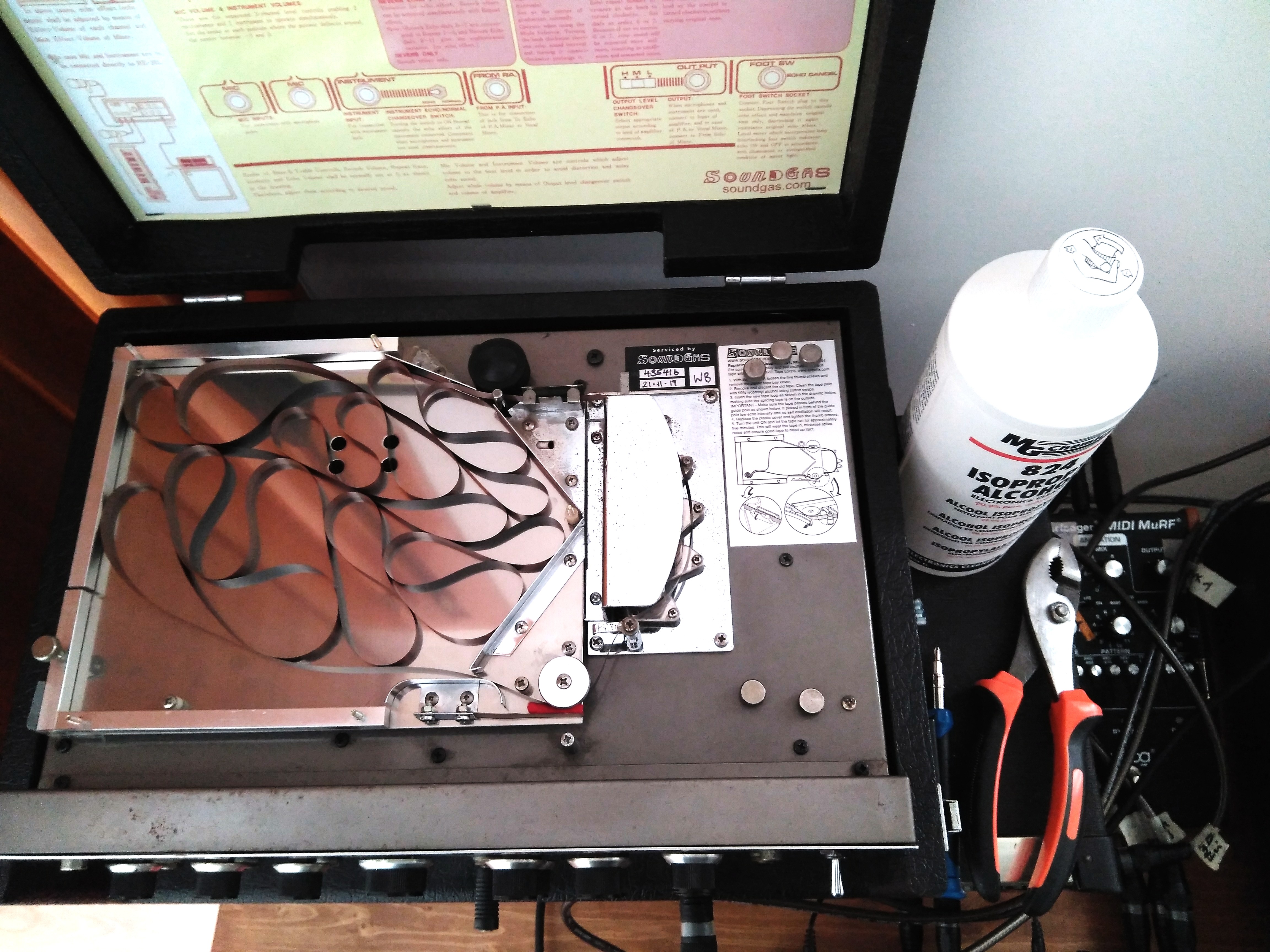
SPACE ECHO TALES – PART III: A QUESTION OF MILLIMETRES, AND THE DIFFERENCE BETWEEN GOOD AND GREAT.
This proved to be a weird moral tale for me: I had wanted to exercise my trust muscle by handing the machine over to someone who – after all – had been recommended to me, and yet what that particular episode taught me was that trusting comes with a risk.
I had managed to undo the damage done by the Barcelona technician, but the splice sound was still happening, so Soundgas sent a video of one of their Echo specialists showing and explaining all the parameters regarding the tension arm itself and its placement. And you know what? All of the parameters on my machine were off. The first clearly visible problem (which had escaped the hawk eye of our specialist in Barcelona) was how bent the arm was, and that was easy to fix. But what really blew my mind was the millimetric work needed for the placement of the arm and the space this leaves for the tape to travel: as I proceeded to carefully adjust it while listening to the sound, I was floored by how the tiniest change influenced the sound for better or for worse.
I did manage to get rid of the splice warped sound. The price to pay for this was a chorusey quality – even sounding like a Leslie cabin on Hammond chords! I am still very proud that I managed to do this, although of course there is no way I could have done it without Soundgas’s guidance.
Parting words: I did send the Echo for a full revision with Soundgas on Monday (I waited this long only because I feared the Echo would sit in a hot warehouse in Madrid customs if I sent it during the summer with a still very young Brexit): the chorusey effect is weaker, but now there is a slightly muddy quality to the sound, which was definitely not there when I first got the Echo. This is what Soundgas is on about when they say that Space Echos should be serviced by people who actually know how great they can sound: could I use my Space Echo as it is right now for this new album I’m working on? Yes, and it would sound very good. But very good is not the same as great, and because I got a stellar Echo in the first place, I know the difference.