
ELKA DRUMMER ONE CLEANING MISSION.
July 1, 2020 § Leave a comment
A few days ago, I was on a mission to try and solve the problem of scratchy pots that had developed on my Elka Drummer One. My instructions: squeeze two drops of the professional cleaner supplied to me by Soundgas into the tiny gap you can see on each problematic pot’s mechanism. I was so nervous that I actually tried to squeeze the drops *without* the tiny tube being pierced, for a good 30 seconds. I then had to turn the pot “at least 15 times”, then repeat the operation. I actually turned the pots 30 times the first time, and then 30 times again the second time, going up to 50 for the two really scratchy ones: the bass drum and the short cymbal. I then had to reassemble the Elka, and test again.

I held my breath as I armed the record function on my DAW. Out of the 5 pots, 3 had become perfectly clean, but the bass drum and short cymbal were *exactly* the same.
This means that I’ve just had to pack the Elka so that it can go undergo a transplant operation at Soundgas headquarters, and I’m not really joking about the transplant thing: Gid told me the “new” (ie 50 year-old!) pots would have to come from a “donor machine”, so I asked him what that meant, wondering if I was missing a joke somehow, and I’ve learnt this is “the term we use for a machine that is giving (“donating”) its parts for spares to keep others going”. Isn’t that amazing?
More thoughts on the beautiful fragility of gear and instruments soon.
NAKED ELKA BEAUTY
June 28, 2020 § Leave a comment
What is this naked Elka Drummer One doing in my studio, rising like the monolith in 2001: A Space Odyssey? Well, this half-century-old beauty started to develop a few scratchy pots, which is no surprise given the less than ideal conditions I had to keep it in for the first part of its life with me (damp ground-floor studio in San Sebastián, Spain). In my Barcelona home studio the dampness situation is better, but still not ideal, especially in the summer months, and I do need to open the windows to let fresh air in, which means I’m also letting in dampness :-(

The lovely folks at Soundgas, who sold me this very rare machine, sent me a special elixir of life, along with instructions on how to proceed with the maintenance operation myself. I was really nervous at first, as it was my first time ever opening *any* piece of gear, let alone a quasi-museum piece, and the phrase “Slide the Elka out of its case” conjured up images of a snake shedding its skin, but… I looooved it!!! I was floored by just how beautiful the inside was, and found it moving to think that the machine was made in Italy in the late 60s, was then mostly used by Krautrock bands in the late 60s-early 70s, is now 50 years later mostly being sold by Derbyshire-based Soundgas, and here I am, a French woman in Barcelona, using it in 2020 :-) I can’t help but wonder who this particular unit belonged to, and if they are still alive.
To open the case I used a screwdriver given to me by my dad some 25 years ago, and the tiny brown box on top of the PA speaker in which I kept the screws was made by my maternal grandfather, and it also felt so right to be using these. I will post more pics this week because it’s just so beautiful, and will tell you how it actually went (suspense).
Artwork on the wall is original egg tempera and oil painting by Iker Spozio for my album A flame my love, a frequency, on Thrill Jockey, 2017.
HOW I KEEP TRACK OF MY MUSIC-MAKING: ALWAYS READY TO PRESS RECORD!
June 21, 2020 § Leave a comment
I have completely closed the gap between the way I compose/make an album and the way I record it, they have become one and the same process, which means that whenever I come up with something that sounds potentially interesting, I’ll record it right away. But I went through many evolutions to arrive at my current setup for recording-as-I-compose (Scarlett Focusrite 18i20 soundcard + Soundcraft Signature 12MTK mixing desk).
For many years (2003-2015) I made music with acoustic instruments, most of the time going through a chain of pedals, one of them being the Boss Loopstation RC20 and then the RC30. Because the way I “compose” is through playing, it made sense to just record on the Loopstation when I got a decent idea, which means that recording the album really was a different process.
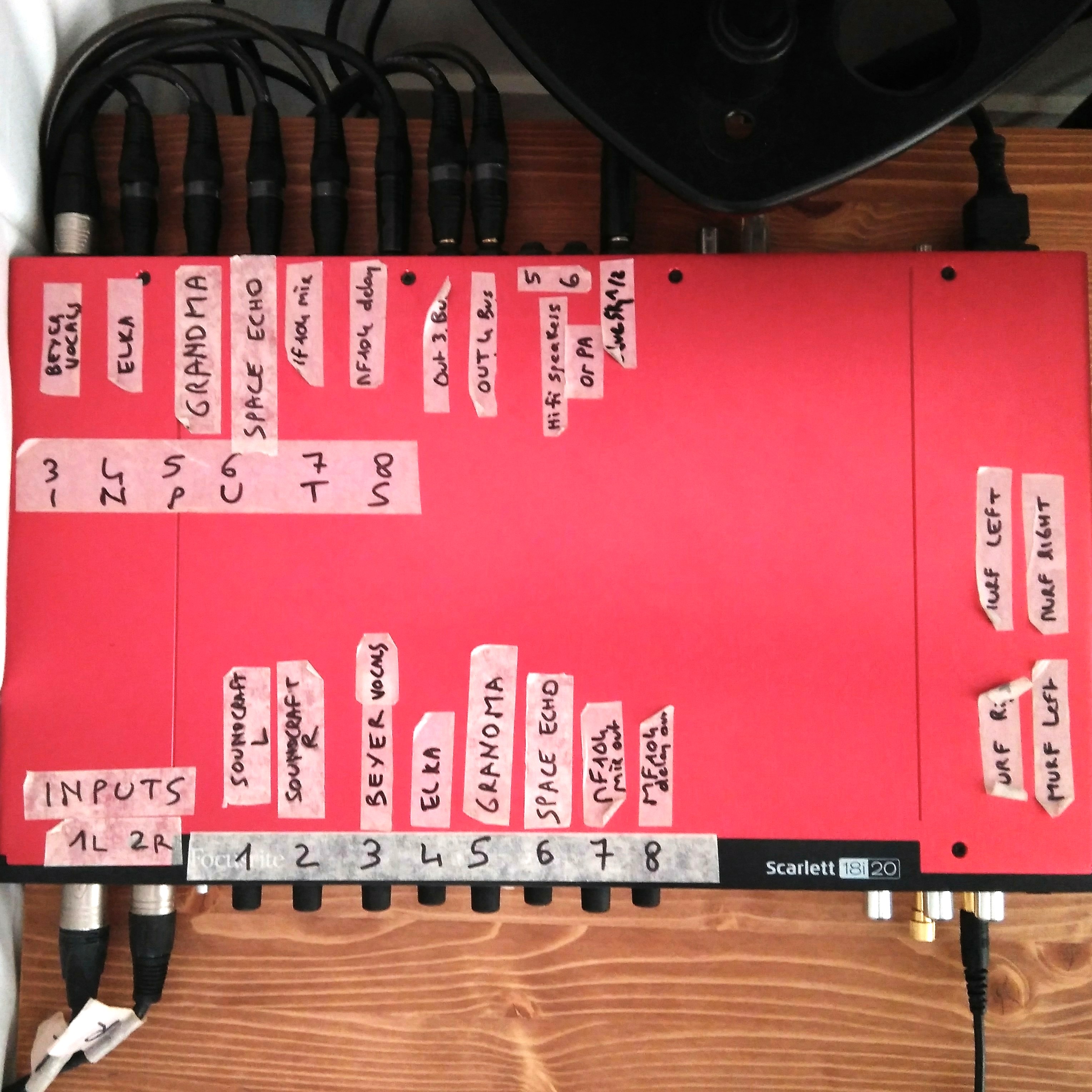
When I shifted to purely electronic music around 2016 with A flame my love, a frequency, one of the guiding principles was to not use looping pedals anymore, and since I had already recorded Captain of none in 2014/15 through my first decent soundcard, the Scarlett Focusrite 18i20, it just made sense to connect my ultra minimal setup (2 Critter and Guitari synths + 2 Moogerfooger pedals) to the Scarlett, and use that setup throughout the composing/recording process, bussing whenever necessary via my DAW (Acid – yes, I know 😁). But when the time came to play A flame live, I needed to bus the instruments and Moogerfoogers physically, which meant buying a mixing desk.

I came to loooooove using a desk, and short of having a fully analogue setup for this new album, I have managed to come up with a lovely hybrid setup, which I’ll share more in depth once I’m done with recording. It took me quite some time to come to something fully operational and that made sense for the way I work, and I don’t think the internet is full of clear descriptions of this kind of setup, so I’ll fill in that void once the real work is over.
HOW I KEEP TRACK OF MY MUSIC-MAKING: IMPROBABLE SCORES AND MESSY TABS.
June 12, 2020 § Leave a comment
Doing things in spite of limitations is a theme I’ll come back to, as it’s been my modus operandi ever since I started making music on my own in the mid-90s, before the Colleen project was even born. My second tool for keeping track of my music-making is a case in point: I write what I call “improbable scores”, scores that have no purpose other than to serve as memory aids, and which lack the “correctness” that would turn them into real scores. Since I’m originally a guitarist, I also use tabs, which presents fewer problems, but of course I’ve only used these when I was using string instruments, which is not the case anymore.
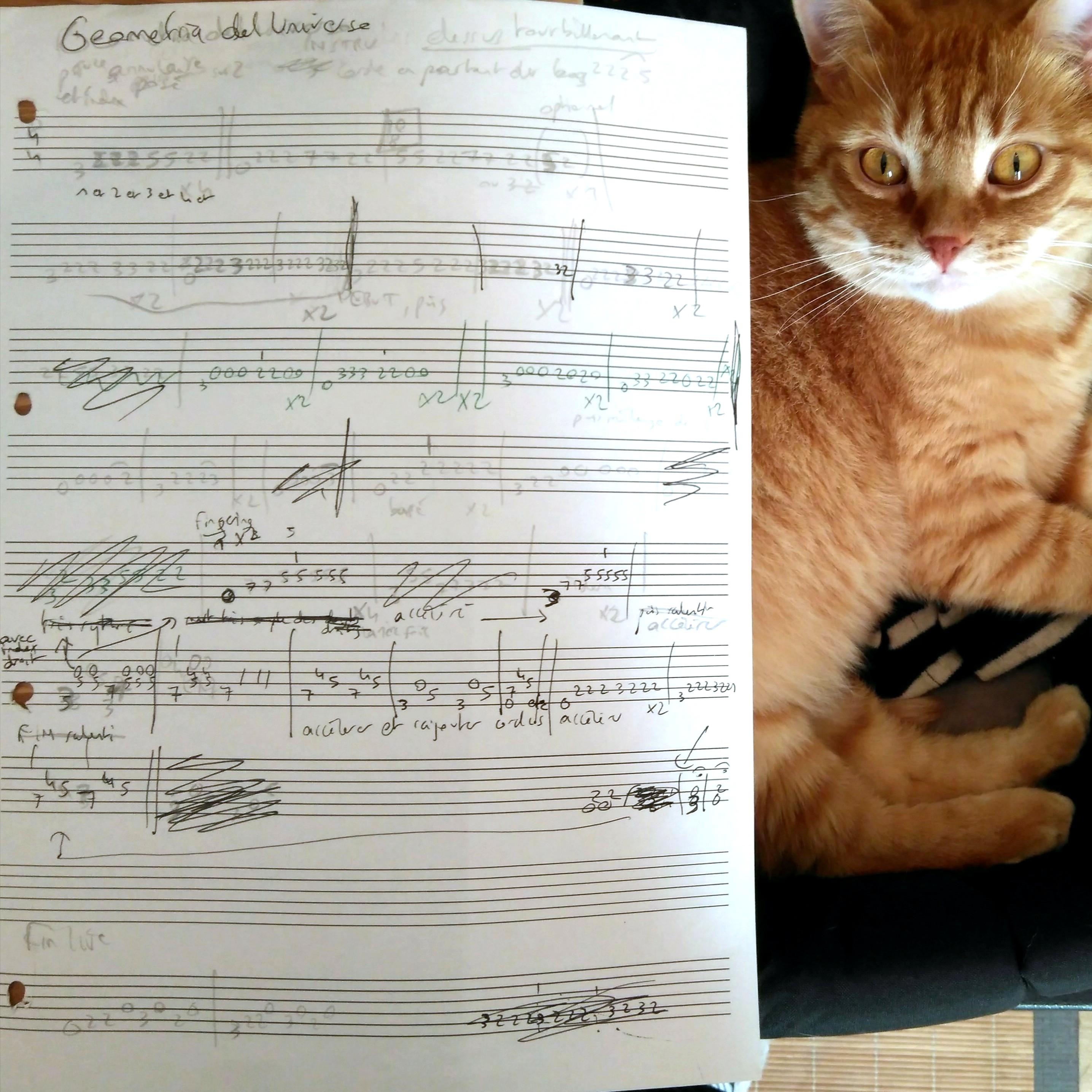
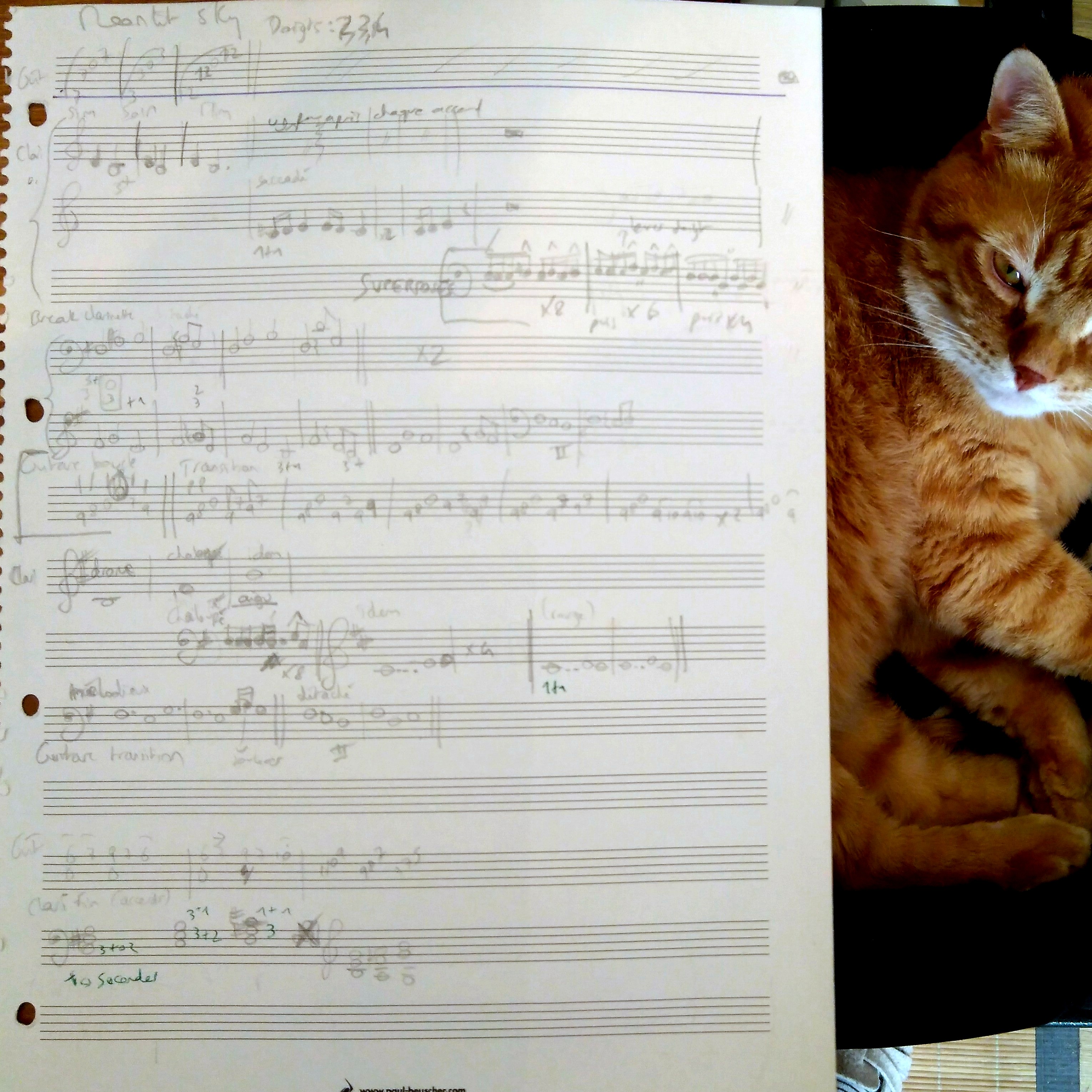
I’m not classically trained, therefore my music-reading (and writing) skills are very limited. I can decipher for the purposes of playing, but only up to a certain point – I got better at that when I took viola da gamba lessons before my 3rd album Les ondes silencieuses, but my limitations were painfully obvious and problematic within that particular context. My 4th album The weighing of the heart is my most “orchestral” album and the one where I’ve used the widest variety of instruments (bass and treble viola da gamba, guitar, clarinet, piano, organ, toy gamelan, hand drums), so I’m attaching a very cleanly written (by my standards) score for “Moonlit sky”, and the very messy tab for “Geometría del universo”, which somehow, to my disbelief, became a kind of “hit” for me in the past few years: this was the first song for which I detuned and fingerpicked my treble viola da gamba, which later paved the way for the Captain of none album, and you can see that the song was born in fits, since the changes in pen colour correspond to nothing other than different work sessions!
HOW I KEEP TRACK OF MY MUSIC-MAKING: GEAR TEMPLATES.
June 6, 2020 § Leave a comment
Part of a new series of hopefully helpful insights into how I keep track of my music-making!
If you’re a musician, I don’t need to ask you if you’ve ever run into the problem of having found a great sound, a great combination of chords/notes with which to combine it, and then a few hours/days later, even though you’re convinced you’ve left the gear in the exact same position and you did take notes about what it was you were doing, you find that it just doesn’t sound the same… We all have run into that problem! It’s happened to me more times than I can count, and the more analogue the gear you are using, the more urgent the problem, especially if, like me, you think that an exciting idea almost always needs refining in order to take it to the level of a song that can end up being released. This is what this new series is all about, starting with the trickiest bit: gear settings!!!
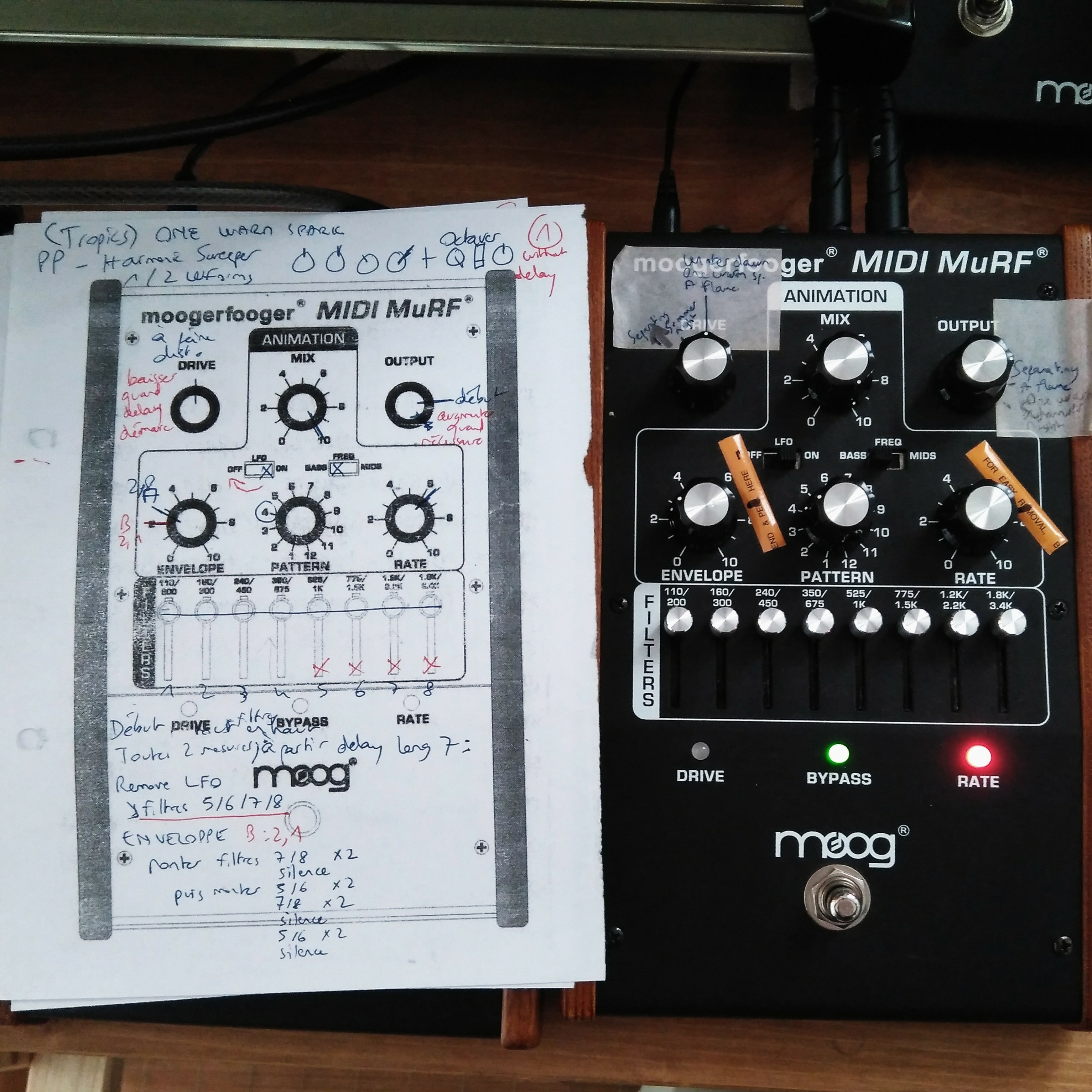
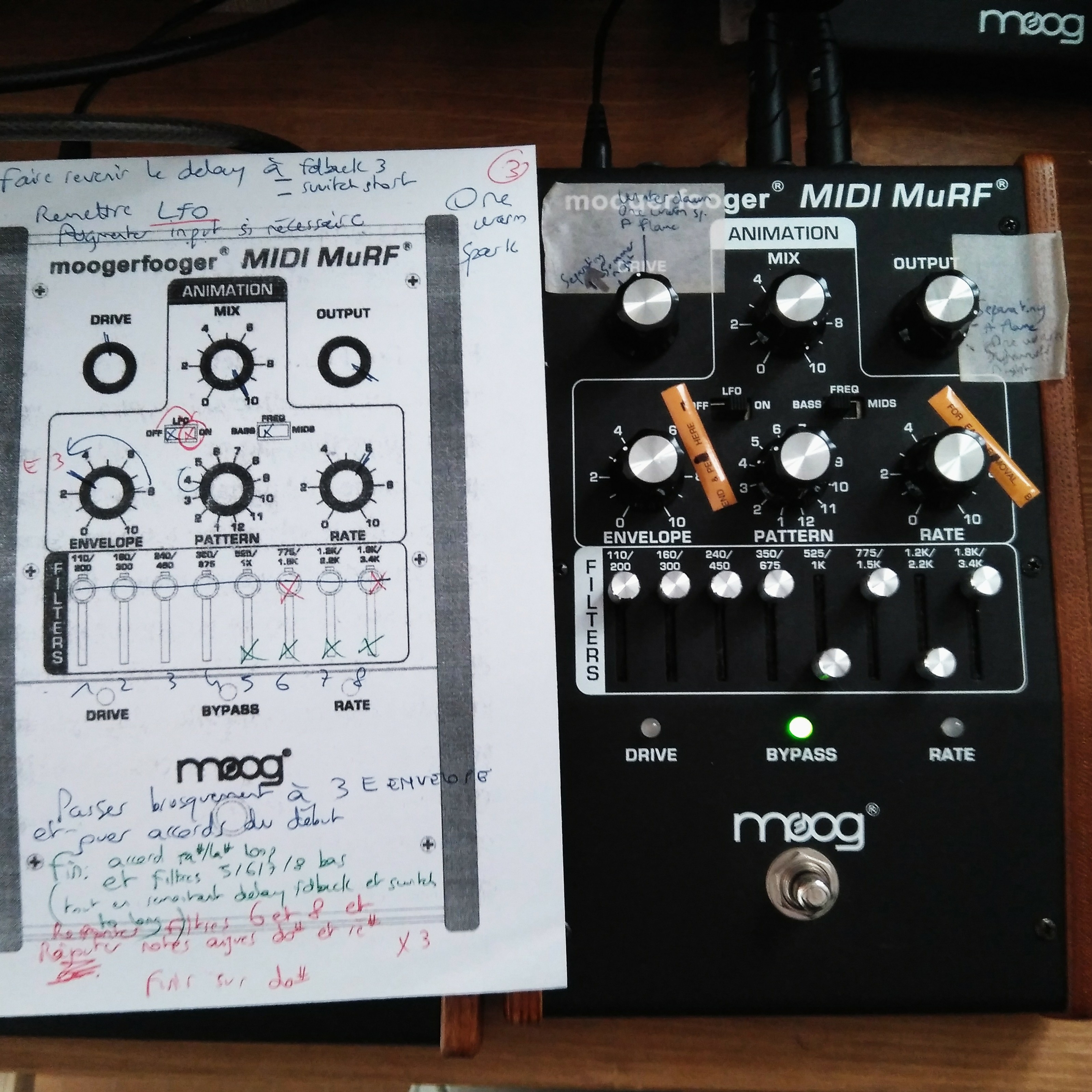
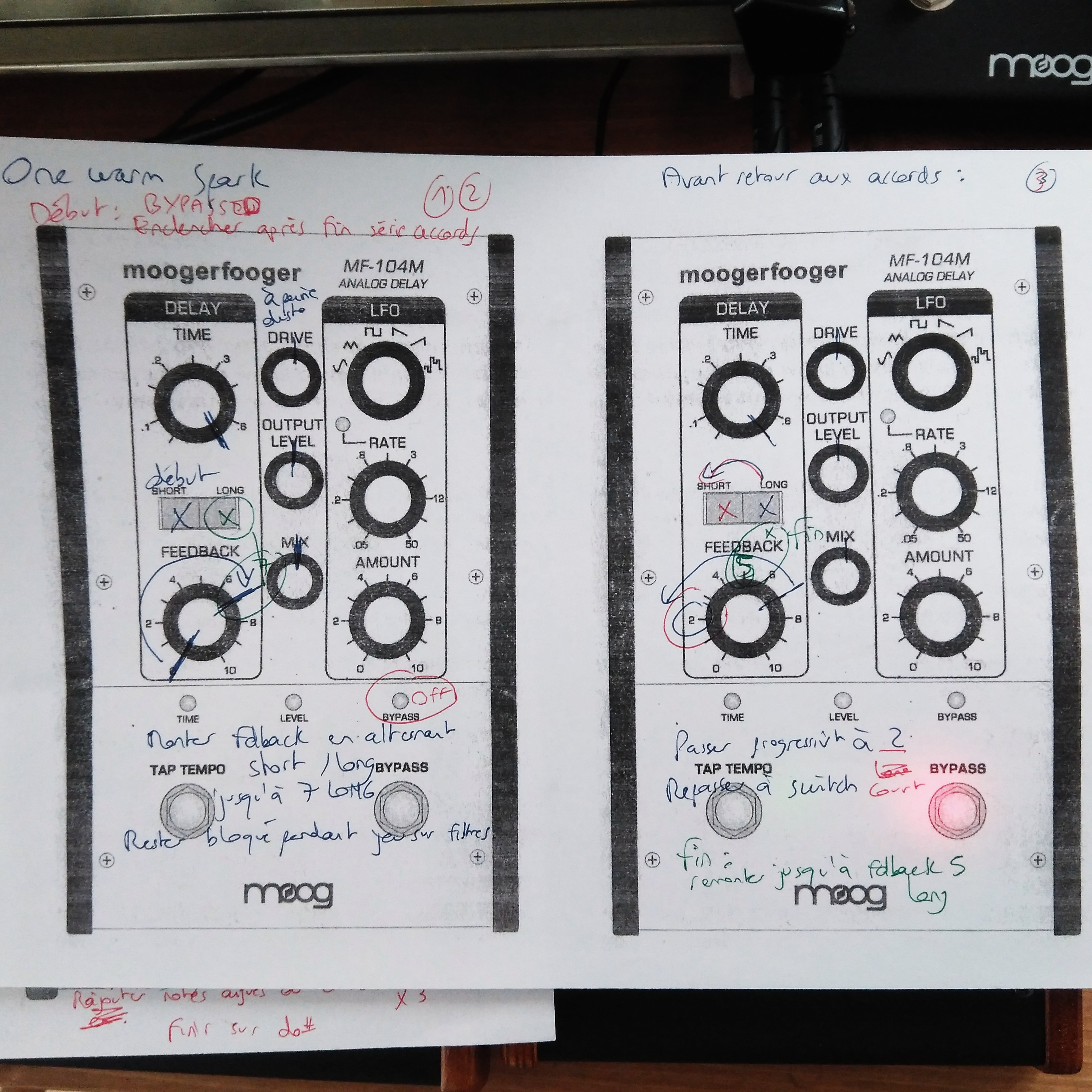
Gear templates are my number one tool: sometimes an intelligent manufacturer provides the users with a preexisting gear template (thank you Moog for doing that with the Grandmother), but most of the time, that’s not the case, so what I do is I take whatever diagram I can find in the manual, and Photoshop it in order to have a version of a size that makes sense for taking notes. I will mark the settings in different coloured pens corresponding to different stages of the song, using numbers and letters when the song involves a lot of changes, and writing actual instructions.
Illustrated example with “One warm spark” from my last album A flame my love, a frequency: a Critter and Guitari Pocket Piano going through an Octabass octaver pedal and the Moogerfooger MF104M delay, sent via an aux to the Moogerfooger MIDIMuRF. There are 3 sheets for the MIDIMuRF, packed full of information as the settings keep changing throughout the song; the delay is a wee bit more static, but still going through its own changes as well. If you can, listen to the song and try to follow my instructions (mostly in French, for some reason!).

This is the methodology I now use for everything I do, and when I don’t, well, I always end up being sorry I didn’t! :-)

